Measure the walls before thinking in cans
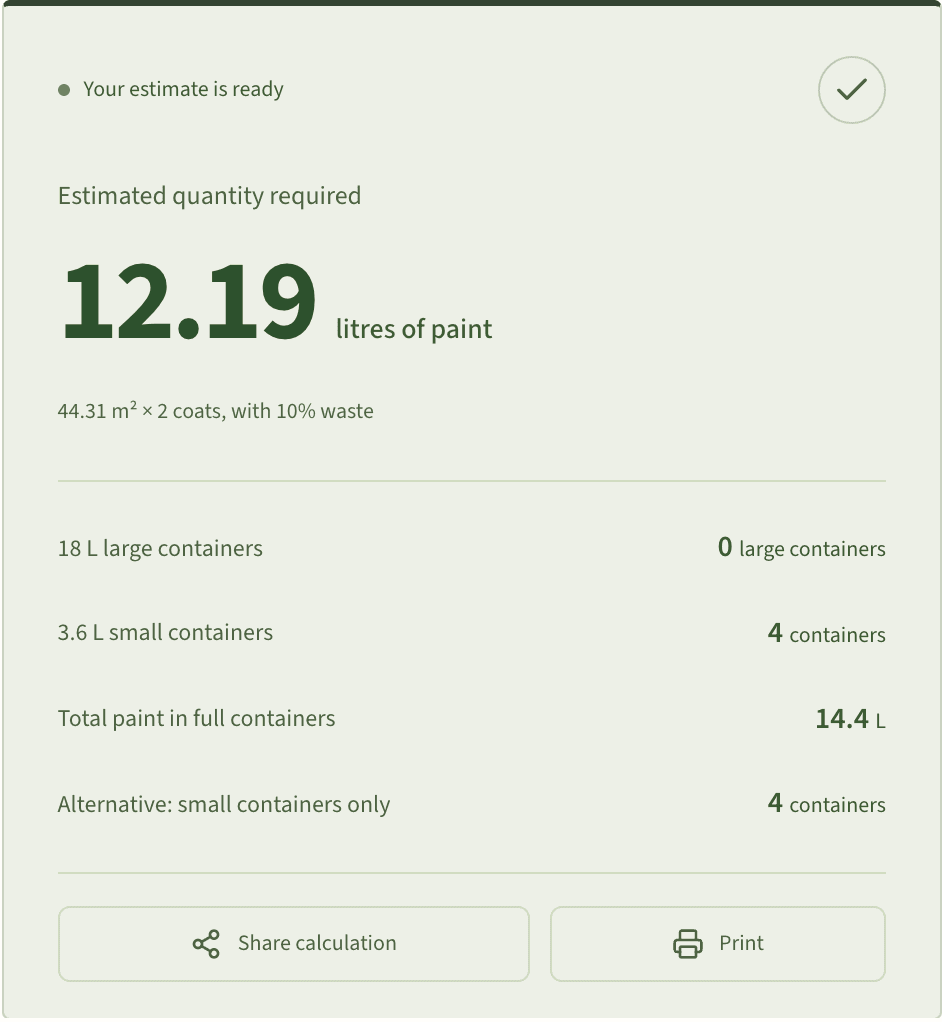
The bedroom in this worked example needs about 12.19 litres of finishing paint, which rounds to four 3.6 L cans. That answer includes two coats and 10% waste, deducts a door and window, and excludes the ceiling. Use the paint calculator to adjust those details for your room; the number of cans is the final step, not the starting assumption.
For a rectangular room, wall area is perimeter multiplied by height. A room 4 m long, 4 m wide and 3 m high has a perimeter of 2 × (4 + 4) = 16 m and gross wall area of 48 m². Its 16 m² floor area does not describe the walls. It can describe the flat ceiling if that surface is included in the painting scope.
A 4 × 4 m bedroom, less one door and one window
- Room height / gross wall area
- 3 m / 48 m²
- Coats / coverage per litre
- 2 coats / 8 m² per coat
- Waste allowance
- 10%
- Door
- 1 × 0.9 × 2.1 m
- Window
- 1 × 1.5 × 1.2 m
- Net walls / ceiling
- 44.31 m² / ceiling excluded
Four cans supply 14.4 L. The 3.6 L ‘gallon’ is a supplier pack label here; check the actual litre capacity and product coverage.
Open this example in the calculatorView the result captured from the calculator
Establish a simple baseline calculation
Before deducting openings, take the full 48 m² of walls, two coats and a coverage assumption of 8 m² per litre for each coat. Multiply 48 by two and divide by eight to obtain 12 litres before waste. With a 10% allowance, multiply by 1.10 to obtain 13.2 litres. This baseline makes it easier to see the effect of the next adjustments.
At 3.6 L per can, 13.2 ÷ 3.6 is about 3.67 cans, so the order rounds up to four, providing 14.4 L. The 1.2 L difference is the mathematical surplus above the allowance-inclusive requirement. It is not a promise of paint left after the work, because practical coverage and the actual surfaces may differ from the assumptions.
Deduct the door and window that are not being painted
The example door measures 0.9 × 2.1 m, removing 1.89 m². The window measures 1.5 × 1.2 m, removing 1.8 m². Subtract both from 48 m² to reach 44.31 m² of net wall area. Include only openings on walls already measured, and use a consistent basis for what will actually receive the selected finish.
The revised calculation is 44.31 × 2 ÷ 8 × 1.10 = 12.18525 litres, displayed as approximately 12.19 L. It still rounds to four 3.6 L cans. A lower measured area does not always reduce the number of whole packs. Keeping the litre estimate visible helps explain the difference without making the rounded order seem arbitrary.
Decide whether the ceiling belongs in this paint order
The flat ceiling measures 4 × 4 = 16 m². If it receives the same paint and colour, add it to the net walls: 44.31 + 16 = 60.31 m². With the same two coats, coverage and waste, the requirement becomes 16.58525 L, or approximately 16.59 L. One 18 L pack supplies enough volume for that calculated example.
If the ceiling uses a different finish or colour, keep it separate. A partly used wall-paint can cannot automatically complete a ceiling painted with a different product. Treat feature walls, doors and woodwork the same way: each material and colour needs its own scope, coverage assumption and purchase quantity. Combining incompatible products makes a neat total that cannot be bought or used as shown.
Coverage matters as much as the room dimensions
The 8 m²/L starting value means one litre covering eight square metres for one coat. It is an editable estimating assumption. Check the selected product's information and discuss the surface condition with the painter. Absorption, texture, preparation and application can change practical consumption; a representative trial area can help establish a more suitable estimate for the work.
For the simpler 48 m² wall example with two coats and 10% waste, coverage of 6 m²/L gives 17.6 L instead of 13.2 L at coverage eight. Keeping coverage eight but increasing from two to three coats gives 19.8 L. These comparisons show the arithmetic effect, not a recommendation for the coating system. Use the product's instructions to establish the required layers and preparation.
Read the pack in litres, even if the shop calls it a gallon
The calculator starts with a small pack of 3.6 L and a large pack of 18 L. In this context, ‘gallon’ is a supplier pack label, not a universal conversion to either a US or imperial gallon. Read the litre capacity printed on the selected product and change the pack sizes before calculating a purchase. The same naming convention should not be assumed across products.
For 35 litres using the default sizes, two 18 L packs provide 36 L. One large pack plus five 3.6 L cans provides the same volume, so the mixed-pack result substitutes the additional large pack. The tool also shows an all-small-can option. These are quantity combinations, not a price comparison; they do not know the supplier's pack prices or promotions.
Make a separate list for each paint system
When several rooms use exactly the same product and colour, combine their litre requirements before rounding cans. That can avoid buying a partly surplus can for each room. Keep primer, filler and other preparation materials on separate lines, using their own consumption information. The finishing-paint calculation does not automatically include them.
Before shopping, review room dimensions, openings, ceilings, coats, practical coverage and pack sizes with the painter. Record the colour and product reference with the printed calculation. If someone suggests a different quantity, those details let you locate the reason: a different surface scope or coverage estimate may explain more than changing the waste percentage alone.
Prepared by the KSA Home Calc team. Content and defaults await professional review before launch. Updated: .