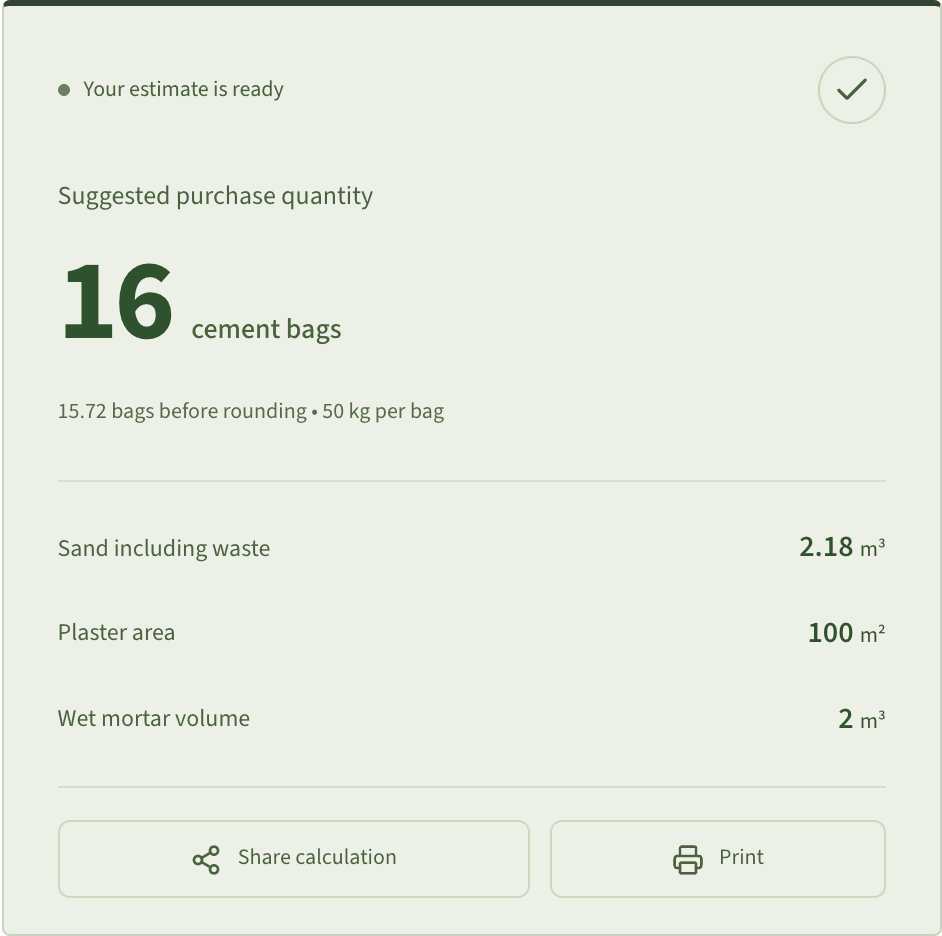
The answer is 16 bags under these stated assumptions
For 100 m² of plaster at 2 cm thickness, a cement-to-sand volume ratio of 1:4, a dry-volume factor of 1.30 and 5% waste, this example needs 16 bags of 50 kg cement and 2.184 m³ of sand. The plaster calculator exposes all these values so they can be checked and changed. The answer is not a fixed consumption rate for every 100 m² of wall.
Before using it, confirm that the 100 m² represents the surfaces receiving this plaster system. A wall of 20 m² may have one plastered face or two. Plastering both starts from 40 m² before reviewing openings and other details. Ceilings, reveals and additional areas should be named in the takeoff rather than hidden in a general allowance.
A worked estimate for 100 m² of plaster
- Area / thickness
- 100 m² / 2 cm
- Cement-to-sand volume ratio
- 1 : 4
- Dry-volume factor / waste
- 1.30 / 5%
- Cement density / bag weight
- 1,440 kg/m³ / 50 kg
Before bag rounding, the cement result is 15.7248 bags. Sand is 2.184 m³. All values are estimating assumptions that need project-specific confirmation.
Open this example in the calculatorView the result captured from the calculator
Convert the application thickness into metres
Area multiplied by thickness gives volume only when the units are consistent. Convert 2 cm to 0.02 m, then calculate 100 × 0.02 = 2 m³ of theoretical applied plaster volume. Entering the number two as metres would be a hundredfold error. Keeping the thickness unit visible is therefore more useful than memorising a bags-per-square-metre shortcut.
The model multiplies the applied volume by a dry-volume factor to estimate the separate dry ingredients. At 1.30, the example becomes 2 × 1.30 = 2.6 m³ before waste. This factor is an estimating convention used in the worked example. Confirm the appropriate basis for the materials and method instead of treating it as an independently verified requirement for every Saudi project.
Divide the dry volume by the stated mix ratio
A 1:4 ratio means one part cement and four parts sand by volume in this calculation, making five parts in total. The cement share is 2.6 ÷ 5 = 0.52 m³. The sand share is 2.6 × 4 ÷ 5 = 2.08 m³. Both amounts are before the selected waste allowance.
Do not read the ratio as one bag of cement to four identical weights of sand. The model uses volume shares and then applies an assumed cement density to convert the cement share to a mass. Likewise, changing the ratio in the calculator demonstrates a quantity change; it does not establish that the new mixture is suitable for the intended surface or application.
Turn the cement share into bags and add waste once
With an assumed cement bulk density of 1,440 kg/m³, the 0.52 m³ cement share corresponds to 748.8 kg. Divide by the 50 kg bag weight to obtain 14.976 bags before waste. Multiply by 1.05 for the 5% allowance: 15.7248 bags. The purchase quantity rounds up to 16 whole bags.
For sand, apply the allowance directly to its volume: 2.08 × 1.05 = 2.184 m³. The displayed 2.18 m³ is a rounded summary; retain the more precise value when checking the calculation. This is not a number of truckloads. The supplier's delivery unit and the contractor's method for checking supplied volume need to be agreed separately.
See how much the average thickness changes the result
At 1.5 cm, with every other input unchanged, the unrounded cement requirement falls to 11.7936 bags, rounded up to 12, and sand becomes 1.638 m³. At 3 cm, the unrounded cement is 23.5872 bags, rounded up to 24, and sand becomes 3.276 m³. Before whole-bag rounding, the quantities change in direct proportion to thickness.
These are sensitivity comparisons, not recommended plaster thicknesses. A drawing may not reveal the surface irregularities that determine the actual average. Ask the contractor or site engineer to establish the thickness and appropriate system. Adding a large waste percentage to compensate for an unknown thickness hides the cause of the uncertainty and makes later comparisons difficult.
Check the material and delivery assumptions
Bag weight, cement density and dry-volume factor all affect the result. Use the bag size you intend to buy rather than assuming every product is packaged at 50 kg. The density is a bulk estimating input used to turn a volume into a mass; the calculator's starting value should be reviewed with the rest of the estimating basis.
Sand is reported by volume, but moisture, handling and the delivery measurement can affect how a purchase is described and checked. Confirm those details with the people supplying and using it. The calculation is most helpful when its unit stays explicit: a cubic-metre estimate should not quietly become a truck count or an assumed weight without an agreed conversion.
Ready-mixed plaster needs a different approach
If you are buying a packaged ready-mixed plaster, begin with the product's consumption rate at the required thickness. Do not apply this cement-and-sand split to those bags; a packaged product has its own composition and coverage information. The same principle applies to additional layers or specialist systems that fall outside the site-mixed plaster being estimated here.
The example also excludes water, additives, preparation materials, mesh and accessories. Keep those items separate, and review the complete scope with the responsible contractor or engineer. Save the measured area and all assumptions with the result. When a material order is challenged, that record allows someone to repeat the calculation and discuss the uncertain input rather than accept an unexplained final bag count.
Prepared by the KSA Home Calc team. Content and defaults await professional review before launch. Updated: .