A cement bag and a premixed plaster bag contain different things
A cement bag supplies one ingredient for a site mix that also needs sand and water. A premixed plaster bag supplies the manufacturer's blend of binders, aggregates and additives. Both bags might weigh 50 kg, but their contents differ. Comparing their bag counts directly, or replacing one with the other on an order, produces a misleading quantity.
For example, Saveto describes Plaster Mix M as a factory-prepared powder containing binders, aggregates and additives. Use the chosen product's consumption data rather than inferring coverage from bag weight. Keep base plaster, key coat and finishing compounds separate: they may cover the same wall but have different thicknesses and consumption rates.
Calculator example: site-mixed mortar for 50 m², not premixed bags
- Area / thickness
- 50 m² / 1.5 cm
- Cement:sand ratio by volume
- 1:4
- Dry-volume factor / cement density
- 1.30 / 1,440 kg/m³
- Cement bag weight / waste
- 50 kg / 5%
The example link opens the cement-and-sand calculation only. Premixed mortar bags use the separate method below; do not order them using the cement-bag result.
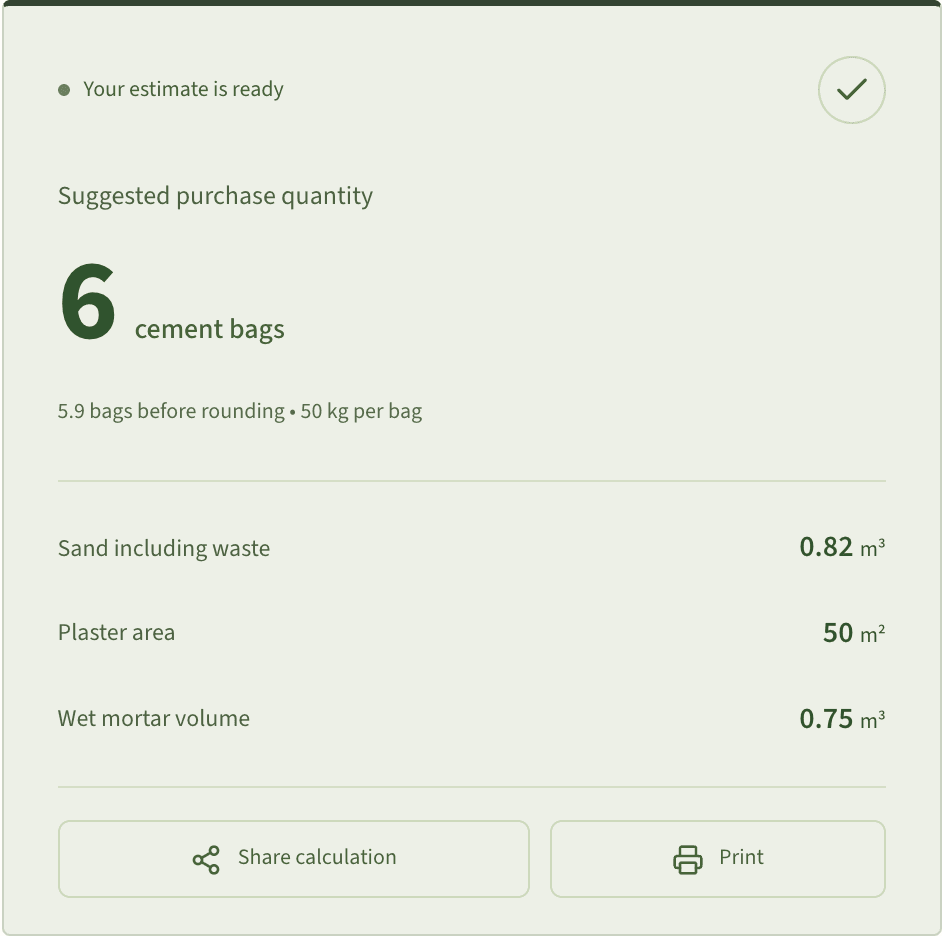
Open the site-mixed plaster comparisonView the result captured from the calculator
Calculate ready-mix plaster from kg/m²/mm
When a datasheet gives consumption in kg/m²/mm, required mass = area in m² × thickness in mm × consumption rate. Apply the chosen waste allowance, divide by the bag weight and round up to whole bags. Convert thickness carefully: 1.5 cm is 15 mm. Using 1.5 in the millimetre formula would understate the quantity tenfold.
As a manufacturer example, the weberpremix SP-5 technical sheet states approximately 1.6 kg/m² per millimetre and a 50 kg bag. For 50 m² at 15 mm, 50 × 15 × 1.6 = 1,200 kg. An illustrative 5% allowance gives 1,260 kg; dividing by 50 gives 25.2 bags, rounded up to 26. Confirm the current local product datasheet before ordering.
How many square metres does one plaster bag cover?
At that same example rate, theoretical coverage per bag = 50 ÷ (1.6 × thickness in mm). A coverage statement without thickness is incomplete. The table converts this rate before waste; it does not establish that every listed thickness is suitable for every product. Application limits come from the selected product's instructions.
| Thickness | Consumption per m² | Approximate coverage per bag |
|---|---|---|
| 10 mm = 1 cm | 16 kg | 3.13 m² |
| 15 mm = 1.5 cm | 24 kg | 2.08 m² |
| 20 mm = 2 cm | 32 kg | 1.56 m² |
Compare with the site-mixed cement-and-sand calculation
The same 50 m² at 1.5 cm represents 0.75 m³ of mortar on the surface. In the calculator's illustrative site-mix model, a dry-volume factor of 1.30 gives 0.975 m³. A 1:4 volume ratio allocates 0.195 m³ to cement and 0.78 m³ to sand before waste. These estimating assumptions need to match the agreed basis for the work.
At an assumed cement density of 1,440 kg/m³, a 50 kg cement bag and 5% waste, the result is 5.8968 cement bags, rounded up to 6, plus 0.819 m³ of sand. The difference from 26 premixed bags does not establish which method costs less. The six cement bags still require the sand and other work items; a premixed bag already contains the manufacturer's blend.
Using litres per bag or m² per bag instead
If the datasheet gives square metres per bag, use that coverage at its stated thickness. If it gives mixed yield in litres per bag, required mortar volume in litres = area in m² × thickness in mm: a 1 mm layer over 1 m² is one litre. Divide by the declared yield, then apply an appropriate allowance with reference to how the manufacturer's rate is defined.
Do not multiply premixed yield by the site-mix dry-volume factor; that imports an assumption from a different method. Check whether a quoted consumption is theoretical or already includes an allowance so you do not count waste twice. Calculate surfaces with different average thicknesses separately, then combine the same product before rounding the final bag order.
Record enough detail for the supplier to check the order
Record the product name, pack weight, consumption rate and units, thickness, net area and waste allowance. Keep the datasheet edition with the calculation. If ordering by weight, use the rounded purchase quantity: 26 bags of 50 kg supply 1,300 kg, even though the example's unrounded requirement is 1,260 kg.
The current plaster calculator estimates cement and sand for a site mix. Replay the example card for that result; use your product's consumption formula for premixed plaster. Neither material quantity automatically includes surface preparation, finishing coats, mesh or labour. Add those items from the agreed project scope.
Sources and product references
These references explain the method or a specific product. Match the product and specification to your project before ordering.
- Weber: weberpremix SP-5 technical datasheet
Source for 1.6 kg/m²/mm and the 50 kg pack. Area and waste are example assumptions; confirm the latest local datasheet.
- Saveto: Plaster Mix M product description
Source for the distinction between a factory blend and cement alone. Weber's rate has not been applied to Saveto's product.
Common questions about this calculation
How many premixed plaster bags do I need for 50 m²?
At 15 mm thickness, 1.6 kg/m²/mm consumption, a 50 kg bag and an assumed 5% allowance, the result is 26 bags. This applies to that stated consumption rate, not to every plaster product.
Are the calculator's cement bags ready-mix plaster bags?
No. The calculator estimates cement and sand separately for a site mix. Premixed plaster bags are calculated from the complete product's consumption rate and pack weight.
Should I apply a dry-volume factor to ready-mix plaster?
Do not add the site-mix factor to manufacturer consumption data. Follow the source rate, units and required thickness; the calculator's dry-volume factor belongs to a different estimating method.
Prepared by the KSA Home Calc team. Content and defaults await professional review before launch. Updated: .